
You open a blank chat. "I run a small business that sells..." Again.
Then your tone. Your audience. What it should not say. You paste an example. Twenty minutes later the draft sounds like everybody's draft, and you edit for another twenty.
That is not AI being slow. That is you training a stranger every single morning.
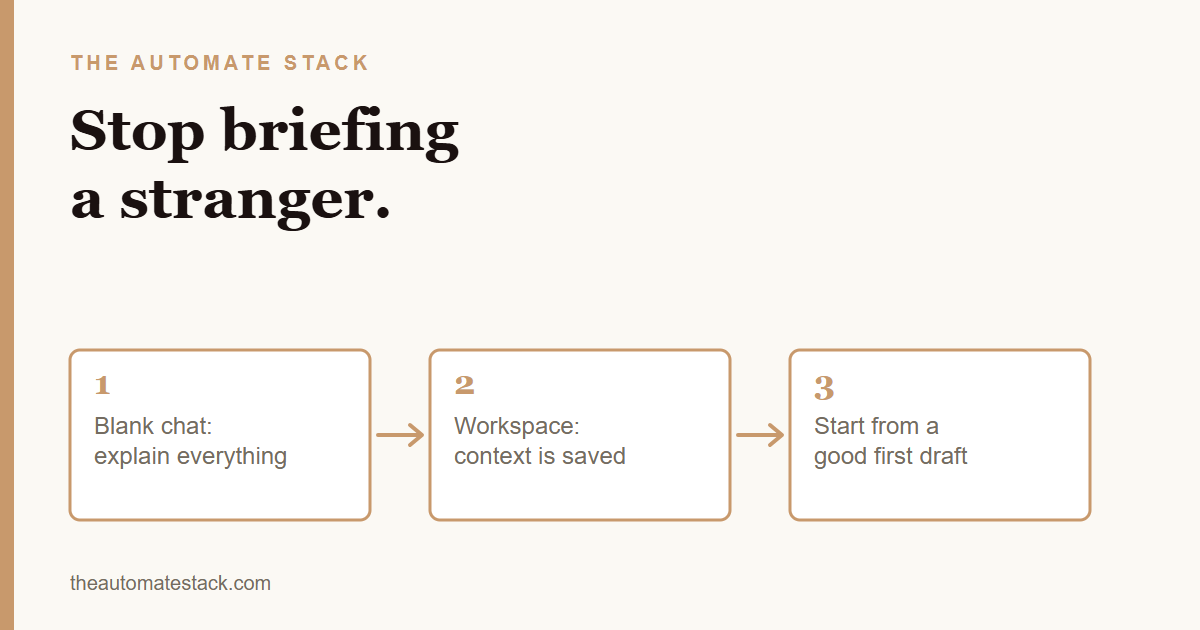
The problem is the blank page
A blank chat knows nothing about you. So every answer starts from the average of the internet, which is why so much AI writing sounds the same. I wrote about that in why everything you write with AI sounds like AI.
A workspace remembers
A persistent workspace, like a Claude Project, holds your context for you. Your brand voice. Your offers. Who you serve. The rules, like words you never use. A few examples of writing you are proud of.
Every new chat inside it starts with all of that already in place.
Say you write captions three times a week. In a blank chat you re-brief each time. In a workspace, you type "caption for Thursday's offer" and get a draft that already sounds like you.
It still needs your eyes
The first draft will be closer. It will not be perfect. You still read it, cut what is off, and add the line only you would write.
The steps
- Pick one recurring job. Captions, weekly emails, client replies.
- Write a one-page brief. Voice, audience, rules, what to avoid.
- Add three good examples. Real writing you like.
- Save it as a workspace. One workspace per job works best.
- Run it for a week. Note what it gets wrong and update the brief.
The Starter Kit has ready setups for this, with the prompts already written, if you would rather not start from nothing.
You would not re-introduce yourself to a colleague every morning. Abeg, do not do it to your tools.