
Your AI does not sound like you because you did not give it you.
That is the whole answer. The rest of this post is how to fix it.
Here is what usually happens. You open Claude or ChatGPT and type: "Write me a post about time management." The tool has nothing of yours to work with. So it reaches for the average of everything it has read. Polite. Tidy. A bit like a brochure.
You read it and think, who wrote this?
And the question you would ask is: so how do I make it sound like me?
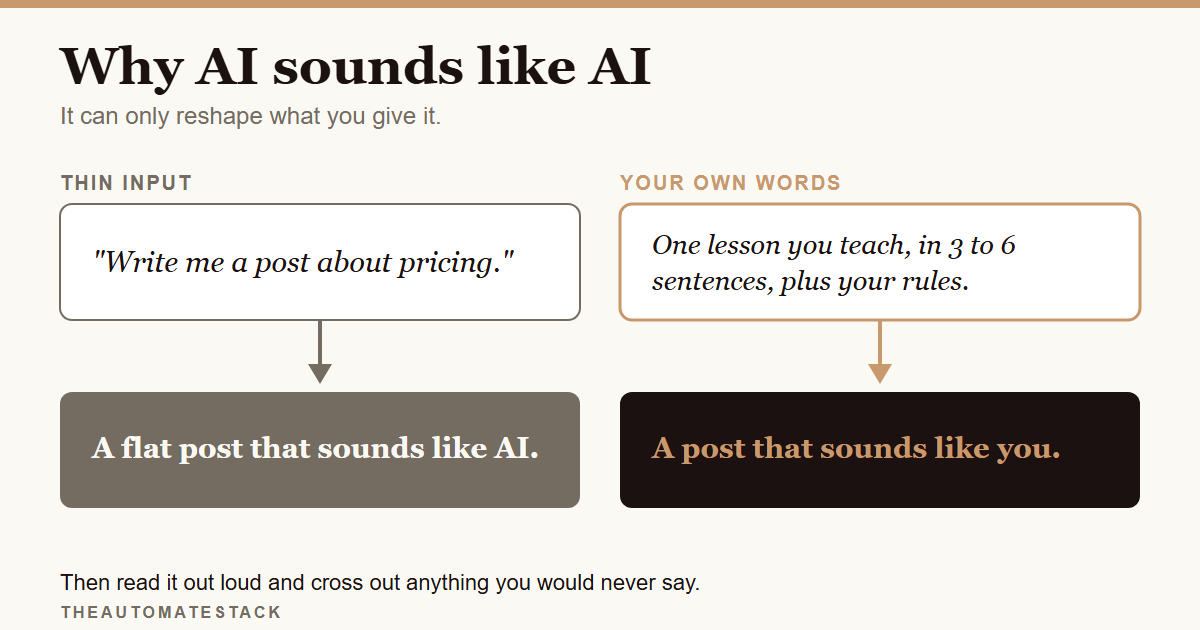
Start with your own words, not an empty box
An AI tool can only reshape what you give it. Thin input gives thin posts.
So give it something real. One lesson you teach, in three to six sentences. If typing feels slow, speak it into a voice note and paste the transcript. Your rhythm is in there. Your odd little phrases too.
Say you coach freelancers on pricing. Here is the thin version you might type: "Write a post about pricing."
Here is the real version: "Most freelancers price by guessing what the client can afford. I price by how long the work takes and what it has to cover. If a client says it is too much, I do not drop the price. I drop the scope."
The first gives the tool nothing to hold on to. The second gives it a view, a rule and a reason. Same tool. Very different post.
Tell it your rules
Most of the "AI sound" is habits. Long sentences. Words nobody says out loud. Neat little lists of three adjectives. Cheerful endings that wrap everything up.
Write your rules once and paste them in with every request. Plain words. Short sentences. No invented stories, numbers or client results. Say the thing, then stop.
Now you want to know if the rules matter that much. They do. Without them the tool goes back to its defaults, and its defaults are what you are trying to escape.
Edit like it is your own draft
This part is not optional.
Read what comes back out loud. Anything you would never say to a friend, cross it out. Anything that sounds too sure about a result you have not had, cross it out. What is left is closer to you than anything you could get in one click.
Then add your own example from a real client or a real day. That is the line no tool can write for you, and it is the line people remember.
Four mistakes that make it worse
Asking for everything at once. One request for a newsletter, ten captions and a video script gets you one flat blob. Ask for less and you get more of you.
Pasting a topic instead of a lesson. "Productivity" is a topic. "Why I stopped checking my phone before I wrote" is a lesson. The tool needs the second one.
Taking the first draft. The first draft is a rough cut. Treat it like one.
Letting it add stories. If a story did not happen, it should not be in your post. Say so in your rules, in plain words, every time.
I know it feels slower than clicking once. But the post you edit for ten minutes is the post people reply to, and the one you click once is the one they scroll past.
The steps
- Write or speak one lesson you teach. Three to six sentences is enough.
- Paste it in with your rules. Ask for your voice, plain words, and no invented stories, numbers or results.
- Read the result out loud. Cross out anything you would never say.
- Add one real example. A real client or a real day, never a made-up one.
- Post one version and watch the response. Change one hook next time and compare.
The full setup for this is in the Starter Kit, in the Create layer. This post is only the reason it works.
I would rather post something plain that sounds like me than something polished that sounds like nobody.