
Do not start with the tool. Start with the task.
Most people do it the other way round. They hear about a new tool, get excited, and go looking for something to point it at. Three weeks later it is sitting there, half set up, and nothing has changed.
So here is a better order.
Picture a normal Tuesday. You answer the same three questions in your DMs. You copy a customer's details into a sheet. You type the same payment details again for someone new. By evening you have done a lot, and none of it grew the business.
And the question you would ask is: which of those do I fix first?
Look at where the hours leak
There are four places time usually leaks in a small business.
- Lead capture and tracking. Someone shows interest and their details end up nowhere.
- Manual work and repeated admin. The same copy, paste and retype, every day.
- Data storage and security. Customer details sitting in places you would not want to explain.
- Platform and audience risk. Your whole audience lives on one app you do not own.
You do not need to fix all four. You need to see which one is costing you most.
Pick the boring one
The best first task to automate is boring. You repeat it often, it needs no real thinking, and you would not miss doing it.
The worst first task is the one that needs your judgement. A difficult customer. A price you have to decide on the spot. Leave those with you.
Say you sell fabric online. Your week list might look like this: answering "is this still available?" in your DMs, sending the same delivery details to every buyer, copying each order into a sheet, posting on Instagram, choosing new stock, and calming a buyer who got the wrong colour.
Cross out choosing new stock and the wrong-colour complaint. Both need your judgement. What is left is repeat work. Of those, the DM questions and the delivery details come back every single day, so they cost you the most time.
That is your first task. Not the clever one. The one that keeps coming back.
Why one at a time
It is tempting to fix everything in one weekend. Please do not.
When you automate one task, you learn how it behaves. Where it breaks. What it does with a typo or a half-finished message. When you automate five, you learn none of that, and you will not know which one is causing the problem.
There is also trust. You will only let a system run unwatched once you have seen it get the small things right. That takes a few days of checking it yourself. Do that for one task before you add another.
The steps
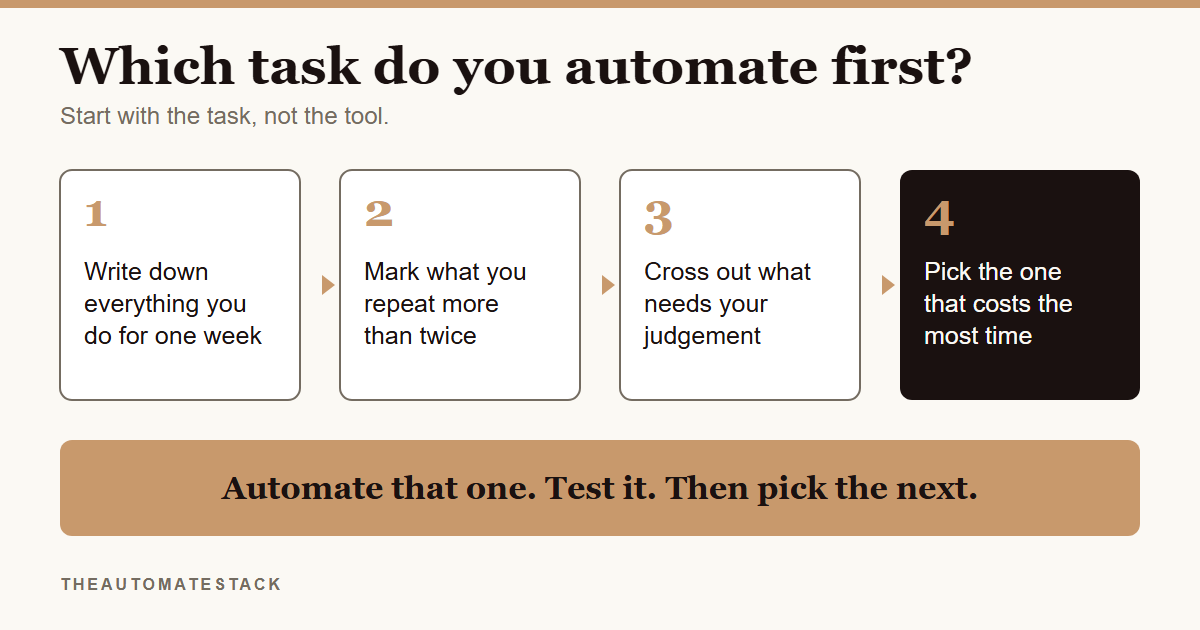
- Write down what you actually do for one week. Not what you think you do. Keep a running list.
- Mark everything you repeat. If you did it more than twice, mark it.
- Cross out anything that needs your judgement. That stays with you.
- Pick the one that costs the most time. Only one.
- Set it up, then test it with messy input. Typos, half sentences, odd requests. If it breaks, fix the setup before you trust it.
- Move to the next one only when the first one holds.
It sounds slow. It is faster than setting up five things and trusting none of them.
If you want a worksheet for the first step, the free AutoStack Checklist is called Get Your Lost Hours Back. You can get it here.
Pick the boring task. It is never the exciting one that gives you your hours back.