
Black Friday does not test your product. It tests your inbox.
Your price may be good. Your photos may be good. But when the messages start coming in, one thing decides the sale: can you answer while the buyer is still interested?
Black Friday is on 27 November this year. That sounds far away. It is not, if you want to do this properly.
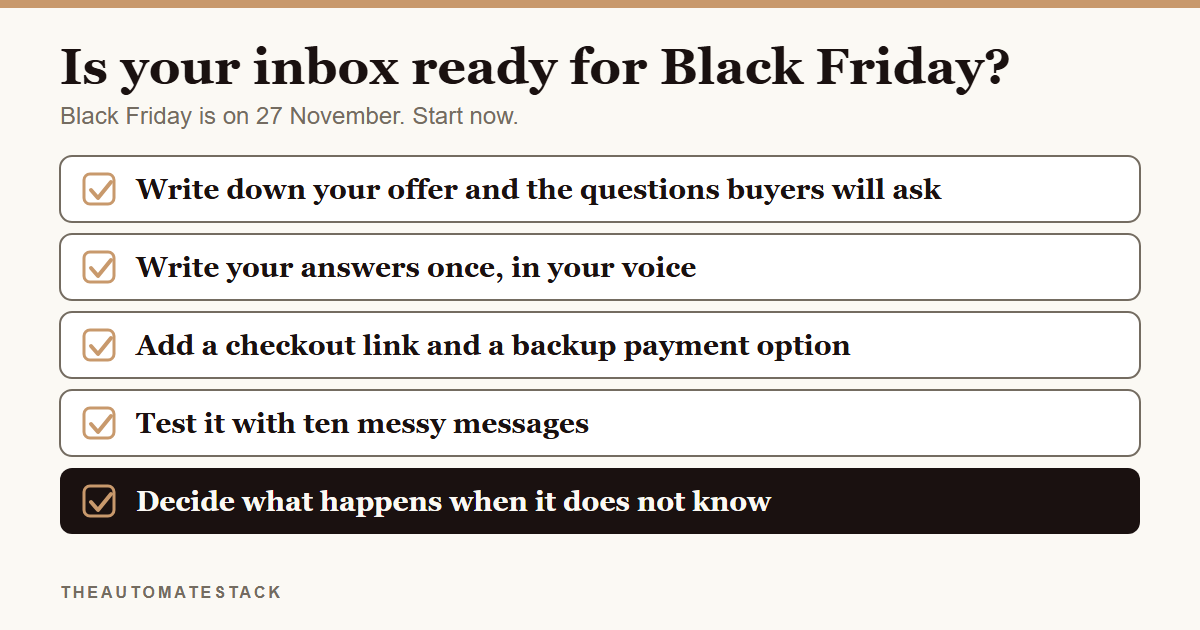
What changes on Black Friday
More messages. The same questions. And buyers who want an answer now, because the next seller is one tap away.
Say you run a small shoe brand. On a normal week you get a handful of messages a day, and you answer them between other jobs. On Black Friday the same questions arrive all at once: "How much is this one?", "Is it still available?", "Does the sale cover this?", "When will it arrive?"
You know every answer. The problem is not knowledge. It is typing the same thing a hundred times while the next buyer waits.
Write your offer down first
Before you write one answer, write your offer in one place. What is on sale. What is not. When it ends. Your last day for delivery.
Do this on paper or in a note, not in your head. If it only lives in your head, you will answer the same question two different ways at 11 PM.
Then write the questions
Open your last busy week of messages and copy out every question. If you have no history, ask a friend to message you as a buyer would.
You will notice something. It is the same ten questions, in different words.
Write the answers yourself
Your answers should sound like you. Short. Clear. With the price, the delivery time and the next step.
This matters even if a system sends them for you. The system sends your words, not its own guesses.
Two ways to pay
Add your checkout link. Then add a backup, like bank transfer details, for the buyer whose card fails. Do not wait until someone is stuck at the payment step to think about it.
Test it with messy messages
Real buyers type like real people. "Price pls." "Abeg, is it available?" Half sentences. Typos.
Send your setup ten bad messages before the sale. If it breaks on one, fix the answer, not the buyer.
Decide what happens when it does not know
No setup answers everything. So decide ahead of time what happens when a buyer asks something you did not plan for.
The simplest answer is honest. Tell them you will reply properly in the morning, and save the message so you can. That is better than a wrong answer, and far better than silence.
The steps
- Write down your offer. What is on sale, what is not, when it ends, your delivery cut-off.
- List the questions buyers will ask. Copy them from your real messages.
- Write your answer to each one. Short, clear, in your voice.
- Add your checkout link and a backup payment option.
- Set up a way to send the answers without you. A system that reads the whole message, not a menu of buttons.
- Test it with ten messy messages. Fix anything that breaks.
- Decide what happens when it does not know.
- Check it once more the week before. Not the night before.
If you want to understand how this works first, you can book a one-on-one consultation. If you want it built for your business, see how the DM system works.
I would rather spend an afternoon on this now than lose sales in the middle of the sale.